
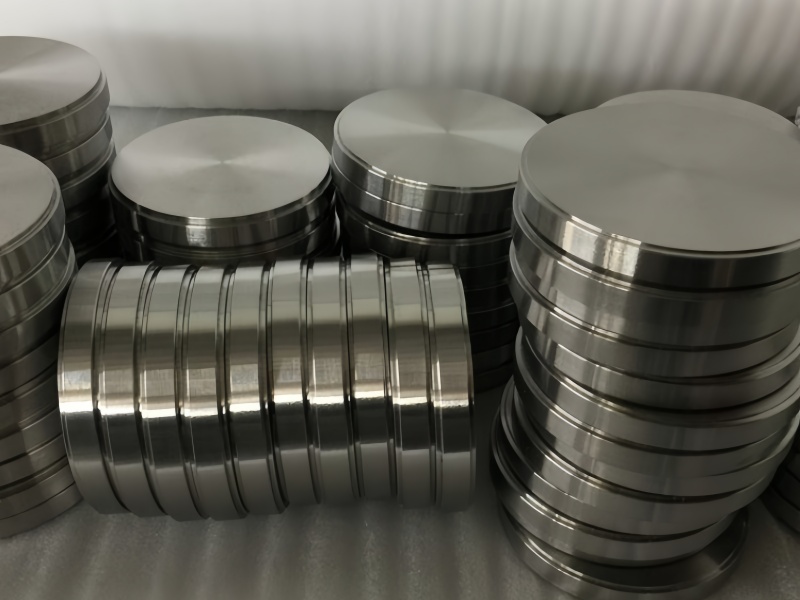
After making titanium alloys for so many years, we often encounter customers asking, "Why is Gr5ELI so much more expensive than Gr5 for the same titanium alloy? ”Today, I will provide a more detailed explanation of the differences between the two.
Gr5 and Gr5eli are two versions of the same titanium alloy, with the main differences in price, interstitial element content, mechanical properties, and application scenarios. The difference between the two will be presented in the form of charts below;
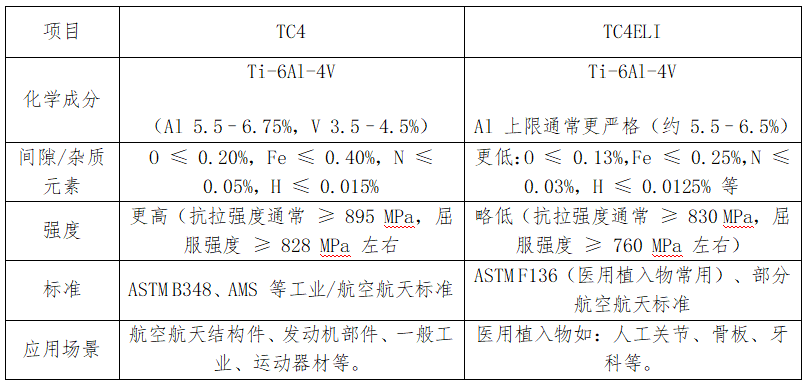
By using the table, we can roughly understand the differences between Gr5 and Gr5eli in terms of products and applications. Now, based on the actual production experience of Yumingda Metal Materials and the industry requirements for titanium and titanium alloys, let's talk about the differences between the two in the production process.
1. Different choices of raw material sponge titanium (the most significant difference).
We all know that sponge titanium has different batch numbers and standard classifications, generally divided into super zero grade A, grade 0A, grade 1, grade 2, grade 3, grade 4, grade 5, etc. Different levels correspond to different purity levels (with varying impurity content) and prices.
Gr5: Generally, grade one or above titanium sponge is often used, and the content of interstitial elements (O, N, C, H, Fe) is allowed to be relatively high.
Gr5eli: High purity titanium sponge (grade 0A or above) and more rigorously screened alloy raw materials must be selected to lower the levels of interstitial/impurity elements such as oxygen, nitrogen, and iron from the source. The cost of raw materials is higher, and the requirements for supplier qualifications and batch consistency are also stricter.
2. Vacuum melting (VAR) has different melting times (i.e. higher purification accuracy)
Gr5: Vacuum consumable arc melting (VAR) is usually used, and two melting processes are generally sufficient to meet the composition requirements.
Gr5eli: In order to reduce the content of interstitial elements to extremely low levels, more thorough purification is needed. It must be purified through three smelting processes. The vacuum degree inside the furnace during the melting process requires higher requirements and stricter control.
3. Different post-processing steps
The forging process is different: the main difference lies in the suitable temperature: Gr5 generally requires one heat forging, while Gr5EL requires two heat forging, and the process requirements are different: three piers and three bars+general forging. Ensure that the Gr5ELI metallographic structure meets higher requirements.
4. Quality Control and Cost
Gr5: Testing according to general industrial/aerospace standards is sufficient.
Gr5eli: The requirements for component testing frequency and sampling are stricter, especially for precise analysis of interstitial elements; Medical grade (ASTM F136) also requires additional tests for biocompatibility, fatigue, fracture toughness, etc. The requirements for process recording and traceability are higher.
Cost difference: Gr5eli is usually 20-35% or even more expensive than standard Gr5.
Different production licenses: There are no special requirements for the production of Gr5. The production of Gr5eli requires obtaining medical titanium material certification. Different customers have different requirements.
In summary, Gr5 and Gr5eli production are not "completely different process routes", but rather impose stricter requirements on raw material purity and smelting purification on the same basic process. Gr5 pursues cost-effectiveness and strength, while Gr5eli obtains higher toughness and lower impurities through higher purification processes, making it suitable for medical implants and low-temperature critical applications. Gr5 is the 'standard high-strength version'. Gr5eli is a "high-purity and high toughness version". Need to choose Gr5 with higher strength; Gr5ELI is preferred for better toughness, low-temperature performance, or for use in human implants.
 +86-0917-3217876
 18292732691
 No. 28, Middle section, Baoti Road, Weibin District, Baoji, Shaanxi
 marketing@ymdtitanium.com
 www.ymdtitanium.com


 English
 简体中文
简体中文
 18292732691
 marketing@ymdtitanium.com
 zyh2968808781
 +86 18292732691
 .cid.b0f8e930cd0ba28e
